Ah, men. Complex creatures indeed.
I am one, and I work exclusively with them. I lead men’s groups, share deep male friendships, and work professionally with guys navi...
View More


Heating shows up on nearly every mid-to-premium male masturbator's spec sheet now. It's also one of the easiest features to fake — a weak, unregulated heating element technically counts as "heated" even if it barely changes the experience, or worse, runs hot enough to be uncomfortable. Here's what temperature is actually doing, and what separates a genuinely well-engineered heating system from a marketing checkbox.
Room-temperature silicone or TPE, at roughly 20°C, feels noticeably different from skin at its natural resting temperature of around 37°C. That gap is exactly why heating became a priority feature rather than a novelty add-on: it closes the distance between "device" and "body-like," and for a lot of users, that's the difference between a mechanical experience and a genuinely convincing one.
The target range that matters most is narrow. Most well-engineered systems aim for roughly 38–40°C — just above resting body temperature, close enough to feel natural without approaching a range that risks discomfort or skin irritation with prolonged contact.
Embedded Ceramic Element — built into the casing
Warms the internal channel indirectly and consistently, typically with tighter, automated temperature regulation. Common in higher-tier devices.
Insertable Heating Rod — separate accessory
Heats the sleeve before use rather than during it. Works with almost any device, but temperature isn't actively maintained once removed, and quality varies significantly between brands.
Infrared / Surface Strips — lining the sleeve
Can heat faster in some designs, but places the heating element closer to skin contact, which makes precise temperature regulation more important, not less.
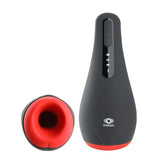
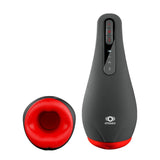
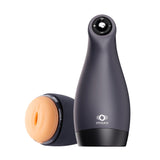
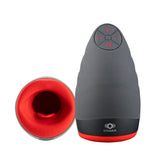
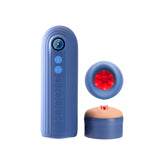
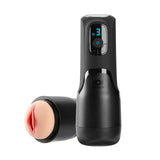
OTOUCH's SmartHeat™ system uses the first approach — a ceramic element embedded in the casing rather than the sleeve itself, autonomously maintaining roughly 38–40°C during use. Built into the AIRTURN 2 and AIRTURN 3, it's designed to hold that range automatically rather than requiring the user to monitor it.
Does the manufacturer state a specific temperature range, or just the word "heated"?
Is there automatic temperature regulation, or does heat continue climbing without a cap?
Does the device auto-shutoff the heating function if left on, as a safety measure?
Is the stated warm-up time realistic, or suspiciously instant given the materials involved?
A device that can't answer the first two questions clearly is worth being cautious about — unregulated heating elements are a real, avoidable risk, not a rare edge case.

AIRTURN 2 with SmartHeat™
Two adjustable heating levels, automatically regulated to stay within a safe, body-like range, paired with 5 suction levels and 6 vibration patterns.
View AIRTURN 2 →This depends on what you value most. If realism is a priority, heating is one of the highest-impact features available — more so than most people expect until they've tried both. If discretion, price, or simplicity matter more to you, an unheated device isn't a worse device, just a different set of priorities. It's genuinely optional, not a feature every buyer needs to chase.
Most well-engineered devices target roughly 38–40°C, just above natural body temperature. Ranges approaching 45°C or higher increase the risk of discomfort or skin irritation, especially with prolonged contact, and are worth treating with more caution.
Well-designed systems generally reach their target temperature within about one to two minutes. Significantly longer times may indicate a weaker heating element; significantly shorter, unregulated times are worth double-checking for safety.
It's a reasonable lower-cost option, but temperature isn't actively maintained once the rod is removed, so the sleeve gradually cools during use. Built-in, regulated heating maintains temperature continuously instead.
It's optional. Heating meaningfully improves realism for users who prioritize that, but a non-heated device isn't inferior — it's simply a different set of priorities around price, simplicity, or discretion.
See our full feature-by-feature buying guide · Browse heated devices
Temperature figures reflect commonly cited industry standards and manufacturer specifications for personal care heating elements. This article is for general educational purposes; discontinue use of any heated device that causes discomfort.

L'OTOUCH AIRTURN 2 est méticuleusement conçu pour offrir une expérience flu...
Boutique
YU BattleHelm — Kit plaisir tout-en-un avec télécommande au bout des doigts, extenseur vibra...
Boutique
SUBMARINE – Masturbateur masculin étanche IPX7 avec poussée automatique, vibrations et contr...
Boutique
Le AIRTURN 4 est un masturbateur à aspiration vibrante avancé, conçu pour offrir une stimula...
Boutique
CHIVEN 2 – Masturbateur buccal masculin chauffant pour un plaisir solitaire personnalisable ...
Boutique
L'INSCUP 4 est un masturbateur masculin de nouvelle génération conçu pour offrir une stimula...
Boutique
Découvrez un plaisir intensément réaliste et un contrôle inégalé avec l'OTOUCH INSCUP 2, u...
Boutique
Découvrez une expérience unique et satisfaisante avec l'OTOUCH MACHO WORK 2, un masseur de...
Boutique
NINJA 2 – Masturbateur masculin gonflable avec ajustement de la fermeté et 7 modes de vibrat...
Boutique| Produit | SKU | Description | Collection | Disponibilité | Type de produit | Autres détails |
|---|