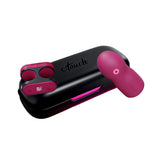
A dead battery mid-session is the fastest way to kill the mood. Most rechargeable sex toy battery life problems are avoidable. A few simple habits — charge to 80%, unp...
View More


That's not a reason to give up on the idea. It's a reason to understand what separates the 15% from everyone else, because the difference isn't luck, it's a fairly specific set of patterns the research keeps identifying.
The study, led by researchers Laura Machia, Christopher Proulx, Isaac Ioerger, and Justin Lehmiller, followed participants over one year and tracked how their arrangements evolved. The outcomes broke down like this:
What's more telling than the romance number is what happened to people who wanted a different outcome. Those hoping their FWB arrangement would settle into a regular friendship got what they wanted 59% of the time, nearly four times the success rate of those hoping for romance. Wanting things to just stay the same was actually the most common hope, reported by 48% of participants going in.
The researchers point to a structural problem baked into how most FWB arrangements start: they're explicitly designed to avoid the commitment and vulnerability that romantic relationships require. Asking that same arrangement to suddenly produce commitment is asking it to do the opposite of what it was built for.
The mismatch problem: When one person wants romance and the other wants things to stay casual, that gap doesn't usually resolve itself quietly, it tends to end the arrangement altogether. That mismatch is likely a meaningful part of why 31% of arrangements in the study ended completely rather than settling into any stable form.

Related research on FWB relationship types has identified a consistent pattern: arrangements that started from a genuinely strong friendship, not just physical attraction or convenience, are more likely to either transition successfully into romance or resolve cleanly back into friendship. Arrangements built mostly around convenience or "just sex" motivations tend to be the ones that end abruptly or drag on unresolved.
Separate research on relationship maintenance behaviors found that people who successfully transitioned from FWB into a romantic relationship reported engaging in relationship maintenance behaviors, things like open communication, expressing affection, and managing conflict directly, more frequently than people in purely casual arrangements. In other words, the couples who made it weren't just hoping harder. They were doing more of the unglamorous relational work the whole time.
Is it ever worth trying to turn a FWB relationship into something more?
If the friendship is genuinely strong and you're both willing to talk honestly about what you want, yes, it's not impossible, just statistically less common than hoped. Going in with clear eyes about the odds tends to lead to better outcomes than assuming it'll naturally happen on its own.
What if my FWB partner says they just want it to stay casual?
Believe them. Research on relationship mismatches suggests continuing the arrangement while hoping they'll change their mind rarely ends well, and it's the pattern most associated with arrangements ending badly rather than resolving cleanly.
Does bringing up feelings always ruin the arrangement?
Not necessarily, but timing and framing matter. A direct, low-pressure conversation tends to go better than letting unspoken feelings build until they come out during a conflict.
Can staying friends with benefits long-term actually work?
For the 25% who wanted it to stay exactly as it was, yes. It's a legitimate outcome, not a failure state, as long as both people genuinely want that and keep communicating about it as circumstances change.
The odds aren't in favor of a friends-with-benefits arrangement turning romantic, and pretending otherwise doesn't improve them. What does improve them, according to the research, is a genuinely strong friendship underneath the physical relationship, honest communication about what each person wants, and the same relational effort a romantic partnership actually requires. If that's already there, the 15% isn't a wall, it's just realistic odds worth going in with your eyes open about.
If you're at the point of having that conversation, our guide on talking openly about sensitive topics covers the same core approach, leading with clarity and curiosity instead of hoping the other person just figures it out.
This article is for general educational purposes and reflects findings from a single longitudinal study; individual relationships vary widely. If navigating this is causing significant distress, consider speaking with a licensed therapist or relationship counselor.

OTOUCH AIRTURN 2 Male Masturbator — Precision Engineered. Deeply Satisfying.Introducing the ...
Shop
YU BattleHelm — All-in-One Pleasure Set with Fingertip Remote, Vibrating Extender & Wire...
Shop
Submarine: An Automatic Thrusting Masturbator Built for Water Most automatic male ma...
Shop
OTOUCH AIRTURN 4 — Automatic Suction & Vibration Male Masturbator AIRTURN 4 is built aro...
Shop
CHIVEN 2 – Heating Oral Male Masturbator for Customizable Solo PleasureDesigned for men who ...
Shop
Experience Unmatched Pleasure with the INSCUP 4 – Premium Male Masturbator with Suction Tech...
Shop
Macho Work 2 Glans Massager — Targeted. Intense. Built for Performance.Most male toys go bro...
Shop
NINJA 2 – Inflatable Male Masturbator with Adjustable Tightness & 7 Vibration ModesThe O...
Shop| Produkt | Artikelnummer | Beschreibung | Kollektion | Verfügbarkeit | Produkttyp | Weitere Details |
|---|